Roofing Debris Is the Heaviest Junk You Will Ever Haul
After more than twenty years running roll-off boxes around Grand Traverse County, I can tell you there is no material that catches homeowners off guard like a torn-off roof. A garage full of furniture, a deck demo, a full kitchen gut - none of it comes close to the sheer tonnage of old shingles. Roofing is dense, it stacks flat, and it hides its weight, so a bin that looks half full can already be riding hard on the axle. If you are planning a tear-off on your Traverse City home or a cottage out on the Old Mission or Leelanau peninsula, the single most important call you will make - after hiring a good crew - is picking the right dumpster. Get it wrong and you are either eating overage fees or watching a driver walk away from a box he legally cannot lift.
The Shingle Weight Math Every Homeowner Should Know
Roofers measure in squares. One square equals 100 square feet of roof surface - a 10-by-10 patch. Shingles are sold and installed by the square, and one square is usually covered by three bundles. That bundle count is your key to estimating weight before you ever pick up the phone.
Here is the rule of thumb I give every caller: a square of standard 3-tab asphalt shingle weighs roughly 225 to 250 pounds as tear-off. Heavier architectural shingle - also called dimensional or laminate - runs 350 to 450 pounds per square, and premium designer product can go higher. Now just multiply. A modest 20-square roof, about 2,000 square feet of surface, comes off at roughly 2.5 tons in 3-tab. That same roof in architectural shingle can push 4 tons. And remember, that is a single layer.
- 3-tab asphalt: about 225-250 lbs per square, or 75-85 lbs a bundle
- Architectural / dimensional: about 350-450 lbs per square, or 120-150 lbs a bundle
- Underlayment, felt, ice-and-water shield, drip edge and nails: add another 10-15 percent on top of the shingle weight
| Roof size | 3-tab weight | Architectural weight | Suggested bin |
|---|---|---|---|
| 10 squares | ~1.25 tons | ~2 tons | 10 yard |
| 15 squares | ~1.9 tons | ~3 tons | 10-15 yard |
| 20 squares | ~2.5 tons | ~4 tons | 15 yard |
| 30 squares | ~3.75 tons | ~6 tons | 15 yard, plan two hauls |
Why Roofing Gets Its Own Small, Dedicated Bin
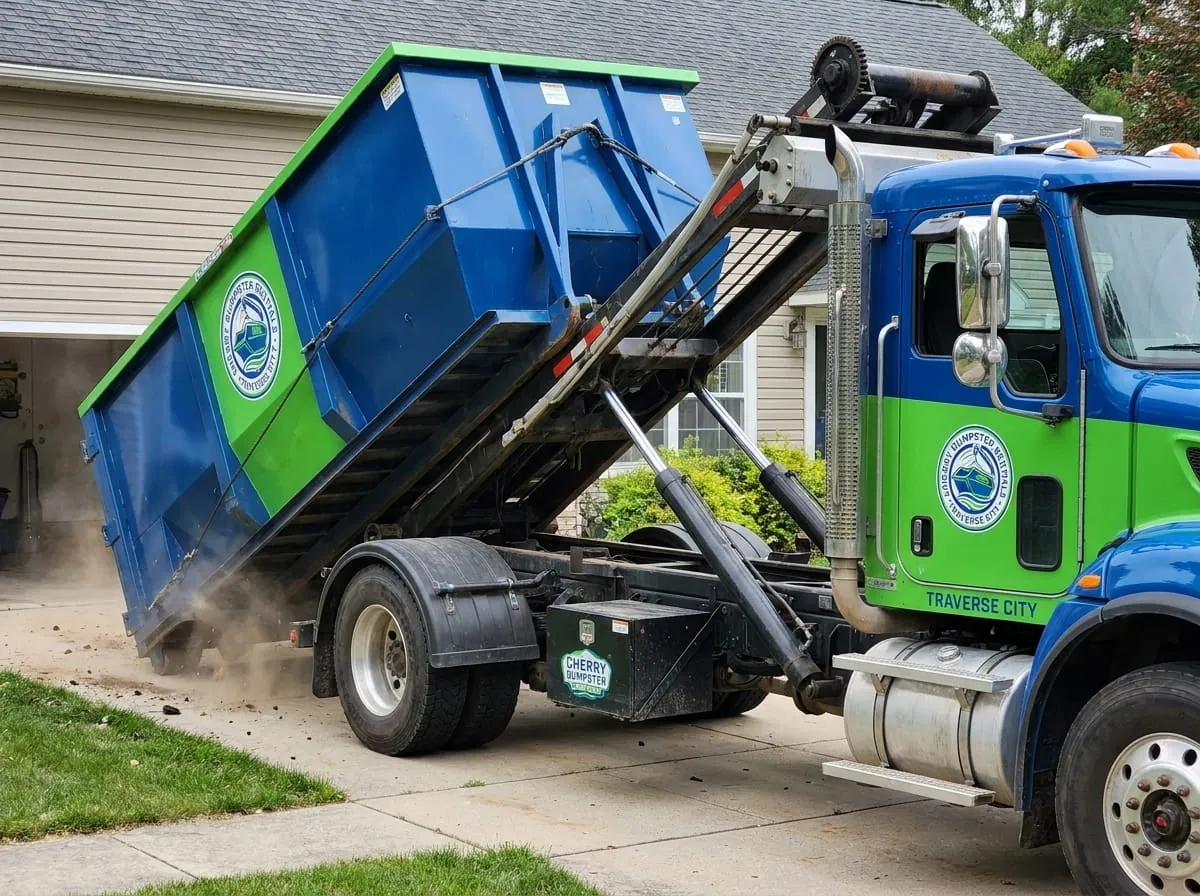
This is the part homeowners fight me on, and it is the part I never budge on. For a roof tear-off you want a small box - a 10 or 15 yard - not the big 20, 30, or 40 yard container you might picture for a job this size. It sounds backwards. The reason is weight, not volume. Those larger cans are built for bulky-but-light material like framing lumber, cabinets, siding, or general household junk. Fill a 30-yard box with shingles and you will blow past the legal road weight for the truck before the bin is even two-thirds full. The driver physically cannot lift it, and even if he could, he cannot legally roll down US-31 with it. A dedicated 10 yard dumpster or 15 yard dumpster matches the tonnage to a container the truck can actually carry, keeps you inside your weight allowance, and gets hauled without a single headache. Think of the small bin as a safety feature, not a limitation.
Estimating Your Squares Before You Call
You do not need to climb up with a tape measure. Two easy methods get you close. First, count the bundles if the shingles are already staged, or ask your roofer how many squares the job is quoted at - that number is on every estimate. Second, use your home footprint: take the square footage of the ground floor, add roughly 10 percent for eave overhang, then multiply by a pitch factor. A common walkable roof runs a factor around 1.3, and a steep cabin roof can run 1.4 or higher. Divide the result by 100 and you have your squares. When you call us with a square count and whether the shingles are 3-tab or architectural, we can size the bin right the first time instead of guessing.
One Layer or Three? Count Before You Commit
Here is the trap that wrecks more roofing budgets than anything else. Michigan code has historically allowed two layers of asphalt shingle on a home, and plenty of older Traverse City houses and cottages are carrying two - sometimes three - layers that were shingled over instead of torn off. Every extra layer stacks the weight right back up. A 20-square roof at one layer might be 2.5 tons; peel two layers and you are near 5 tons; three layers and you are hauling as much as a small foundation demo. Before you order a dumpster, get up in the attic or lift a shingle edge at the rake and count the courses. If you find more than one layer, tell us up front so we can plan a swap-out or a second haul instead of leaving you with an overloaded box you cannot get emptied.
The Northern Michigan Reality: Snow Load, Ice Dams, and a Short Season
Roofs up here do not fail politely. Lake-effect snow off Grand Traverse Bay piles feet of wet, heavy load onto rooflines, and when attic heat melts the underside, that meltwater refreezes at the cold eave and builds an ice dam. Water backs up under the shingles, soaks the decking, and rots the sheathing - and by spring a lot of homeowners are looking at a re-roof they did not budget for in November. That is the classic northern-Michigan tear-off: driven by winter, discovered in the thaw. The other reality is the calendar. Our reliable roofing window is short, roughly late spring through October, with crews slammed the whole time. Cold-weather tear-offs happen, but asphalt shingle gets brittle below about 40 degrees and sealant strips will not tack down, so most crews chase the warm months hard. If you are lining up a re-roof, book your dumpster the same week you book your roofer - during peak season the good bins move fast, and a tear-off with nowhere to put the debris stalls the whole crew.
Cottages, Cabins, and Steep Pitches
A lot of the roofs we service are not simple ranches. The cottages and A-frames around the lakes carry steep pitches, dormers, and complicated valleys, and a steep roof has far more surface area than its footprint suggests - which means more squares and more tonnage than a homeowner expects. Steep-pitch tear-offs also throw debris a long way, so shingle fragments and nails scatter across the yard and driveway. On these jobs the small, heavy-duty roofing bin really earns its keep: it sits close, it fills with dense material, and it gets swapped before the weight becomes a problem. If your place is a seasonal cottage, tell us about access - narrow two-tracks, soft shoulders, and low tree branches all change where we can safely set a box.
Protecting Your Driveway and Placing the Bin
A roll-off box loaded with shingles is one of the heaviest things that will ever sit on your driveway, and tear-off debris rains down with nails in it. Two moves save you grief. First, put plywood or 2-by lumber under the container wheels and rails to spread the load - asphalt driveways soften in summer heat and a loaded roofing bin can leave dents or cracks without protection. We walk through exactly how to do this in our guide on protecting your driveway during a dumpster rental. Second, placement is everything on a tear-off. Set the bin as close to the roofline drop zone as you safely can so the crew is chucking shingles a short distance, not hauling them across the yard. Position the open end toward the slope they are working, keep it clear of overhead power lines and low branches, and leave the truck a straight, firm pull-out path. A well-placed box speeds the whole job and keeps stray nails off your lawn and out of your tires.
Avoiding Overage Fees
Overage fees are almost always a weight surprise, not a volume one. Your rental includes a tonnage allowance, and roofing debris eats through it faster than any other material. Stay ahead of it three ways: know your squares and shingle type before you order, count your layers honestly, and load the bin evenly rather than mounding it at one end. Do not toss in extra junk - old lumber, a busted grill, yard waste - just because there looks to be room; every pound counts against the same allowance. When in doubt, size down and plan a swap. Two right-sized hauls almost always beat one overloaded box that gets refused at the curb. Give us the roof details and we will tell you straight whether one bin covers it or two will save you money.
Get Your Traverse City Roof Tear-Off Sized Right the First Time
A re-roof is stressful enough without a dumpster surprise. Cherry Dumpster Rentals delivers weight-rated roofing bins across Traverse City and Grand Traverse County, and we will size your box to your squares, your shingle type, and your layers so you never eat an overage fee. Learn more about our roofing dumpster rental service, or call us and we will have the right bin at your place ready for the crew. Call (231) 642-9756 today.

Founder, Cherry Dumpster Rentals — sharing straight advice from more than 15 years of local hauling experience.
Frequently Asked Questions
What size dumpster do I need for a roof tear-off?
For most residential roofs, a 10 or 15 yard dumpster is the right choice. Roofing debris is extremely heavy, so you size the bin by weight, not volume. A 10 yard box handles roughly 10 to 15 squares of single-layer shingle, while a 15 yard box covers most 15 to 25 square jobs. Larger 20 to 40 yard containers are a mistake for roofing because the truck cannot legally or safely lift them once they are loaded with shingles.
How much does a square of shingles weigh as tear-off debris?
A square of standard 3-tab asphalt shingle weighs about 225 to 250 pounds, and heavier architectural or dimensional shingle runs 350 to 450 pounds per square. Add another 10 to 15 percent for underlayment, felt, ice-and-water shield, and nails. A typical 20-square roof comes off at roughly 2.5 tons in 3-tab or up to 4 tons in architectural shingle, and multiple layers multiply that figure.
Why can't I just rent one big dumpster for my whole roof?
Because shingles are dense enough to exceed the truck's legal road weight long before a large container looks full. A 30 or 40 yard box packed with roofing debris cannot be lifted or hauled safely or legally. A smaller 10 or 15 yard bin matches the tonnage to what the truck can actually carry, which is why every seasoned operator recommends a small, dedicated roofing dumpster and a swap or second haul if needed.
How do I know if my roof has more than one layer of shingles?
Lift a shingle edge at the rake or gable and count the courses stacked on the decking, or check inside the attic where the roof edge is sometimes visible. Many older Traverse City homes and cottages were shingled over rather than torn off, so two or even three layers are common. Each extra layer roughly doubles or triples the tear-off weight, so count your layers before ordering a dumpster and tell your rental company so the bin is sized correctly.
When is the best time to schedule a roof tear-off in northern Michigan?
The reliable roofing window here runs from late spring through October, since asphalt shingle turns brittle and sealant strips will not bond well below about 40 degrees. Many re-roofs are driven by winter snow load and ice-dam damage discovered in the spring thaw, and crews book up fast during the short warm season. Reserve your dumpster the same week you book your roofer so the tear-off is not held up waiting on a bin.